If it weren’t for the Robertson County archives, the Fykes might’ve unknowingly demolished their own family heirloom.
The homeowners had just purchased an 1880s farmhouse in Cedar Hill, Tennessee, with the intention — seemingly their only option — of tearing it down.
“It was in such a state of disrepair,” says interior designer Sarah Capps, a Robertson resident who works in Sarah Stacey Interior Design’s Nashville office. “It was like a hoarding situation, and then abandoned with all that stuff in it.”
A name changed the home’s fate. Its address, on Fykes Grove Road, piqued the new owners’ curiosity: Could this be part of the original land grant from their earliest American ancestor, a Fyke who’d fought in the Revolutionary War?
The archives had answers.
“They saw the house,” remembers Capps. “It was listed as ‘The Fyke House,’ and one of their ancestors had built it. They’re like, ‘Well, now we have to save it.’”
FINDING FUNCTION, KEEPING CHARACTER
The decision was easy. The process of rescuing the nearly 150-year-old home? Much more complicated.
Nearly two generations since those early Fykes built and loved it, the stately but simple vernacular farmhouse now bordered on crumbling — covered in rust and rot, filled with long-forgotten furniture and trash, ivy vines growing straight through the walls.
The new stewards carefully cleared out remnants and refuse from past renters and started some of the significant demo work. But once they got into it, the full scope of the project became apparent.
“They saw, ‘Oh, we need help,’” Capps says. “’This is more than we can tackle on our own.’”
Sarah Stacey Interior Design had been tapped to help shape plans for a new build. Their task — reimagining a historic property that seemed beyond help, adding modern function and comfort while honoring the history that made it priceless.
“They’re very sentimental people,” Capps says of the homeowners, “so they wanted to save a lot — as much original as they could. But when it’s in that state, you want to keep the character, but you also want the house to be comfortable for them to live into their retirement. This is their forever home.”

A COLLABORATIVE EFFORT
As restoration and renovation began, history commanded restraint. In its heyday, the classic farmhouse wouldn’t have featured much flair, but the designers and homeowners saw opportunities for creativity too.
Ultimately, bridging that gap became a collaborative effort.
The team figured out how to install modern ductwork without crowding the comfortable historic ceilings. They managed to save a share of original details — upstairs floorboards, brickwork inside the fireplaces and on the chimneys, even some of the original framing.
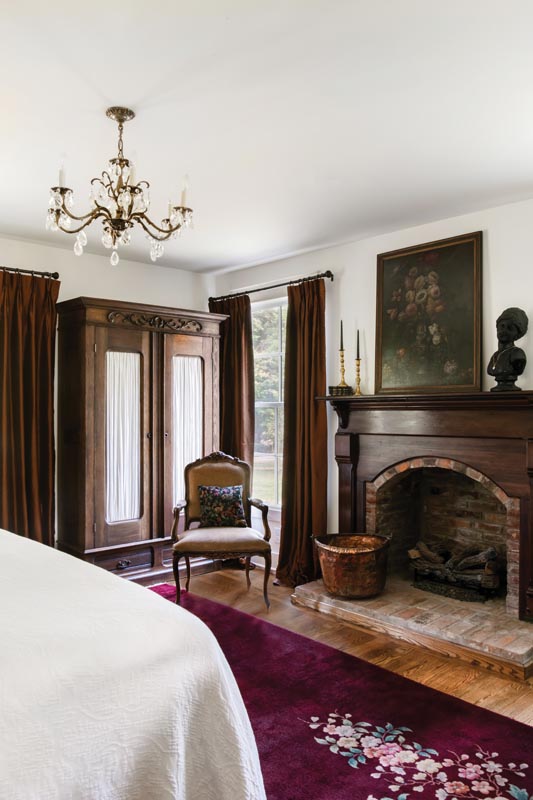
The homeowners carefully restored the original mantel in the primary bedroom and built other mantels to match.
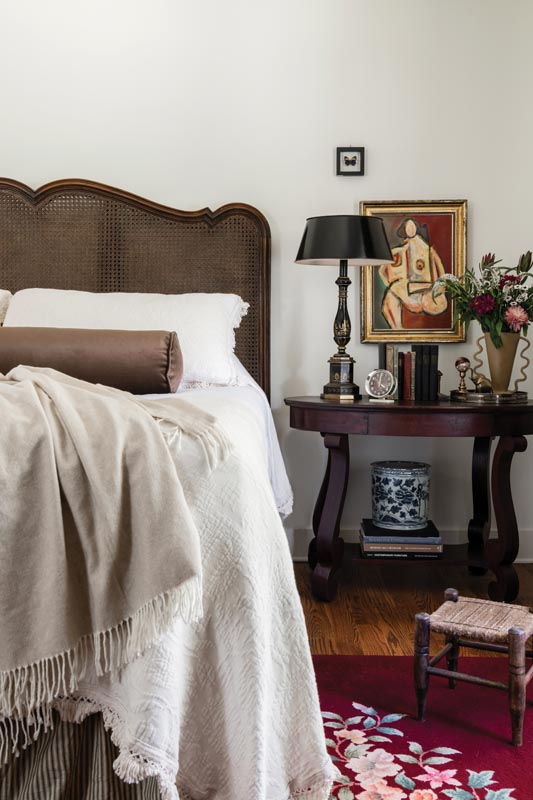
For other finishes and furnishings, the design team and clients sourced and selected an eclectic mix of new pieces and heirlooms and antiques that referenced the past but fit for the family’s future.
OLD, NEW, MIXING THE TWO
For the living room, the Stacey team found an antique rug and a cache of vibe-setting paintings at Debbie Mathews Antiques & Designs in nearby Nashville. They pulled pint-sized vintage chairs up to an easy antique coffee table. They added a tapestry found at a flea market in Paris, and made pillows out of vintage overshot blankets and new floral fabric that’ll be part of the forthcoming Sarah Stacey fabric and wallpaper line, likely out in 2026.
The homeowners had a collection of decorative plates, including vintage Majolica pottery, which Capps arranged in wall displays to add interest in the living and dining rooms.
In the dining space, the Fyke family silver sits in a hutch near another lucky find — framed photos whose full importance only recently became clear.
“They had a bunch of old black and white images, and were looking back at them after they bought the house,” Capps says. “They’re like, ‘Oh, that’s our house.’”
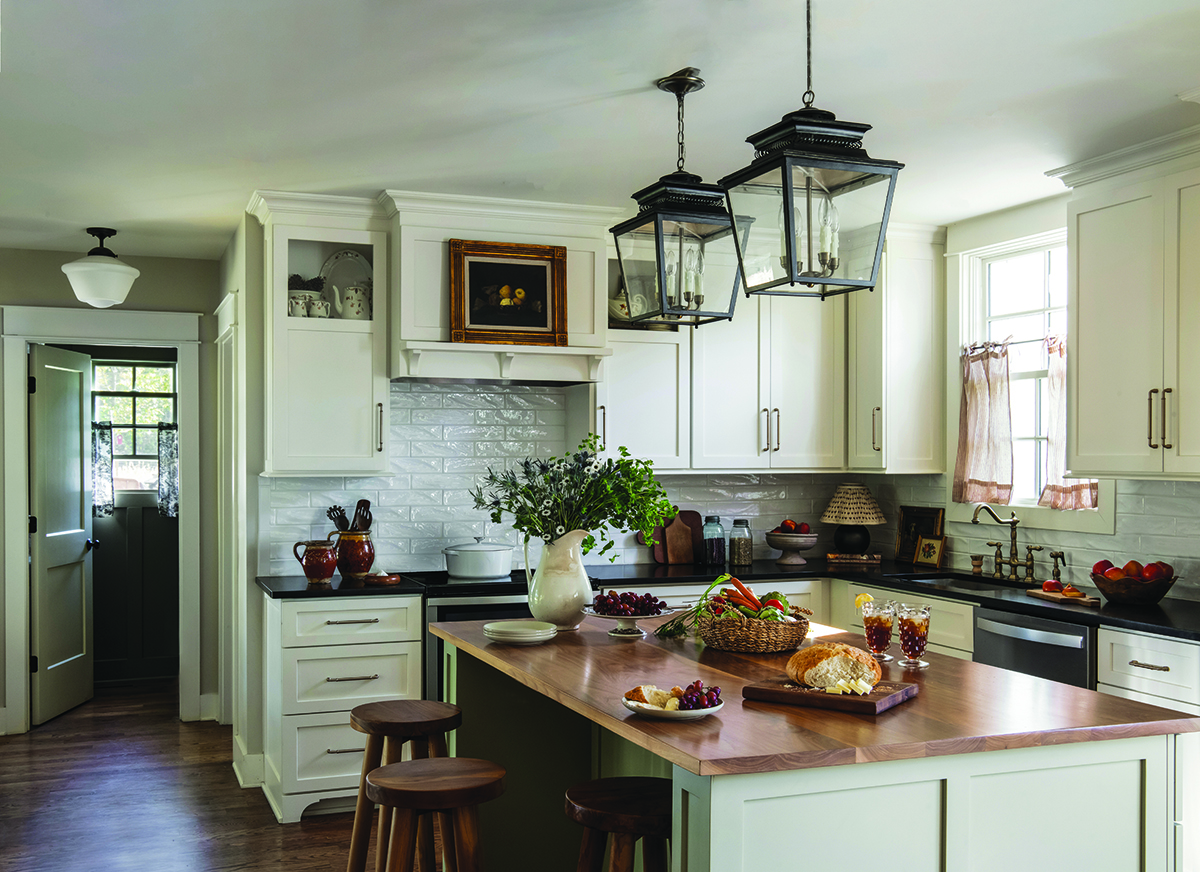
The kitchen stayed simple at the homeowners’ request, with clean lines, warm wood tones and subtle pops of color. But a ledge on the range hood offered a place to play with art, and the Fykes have turned that into a rotating gallery.
“It was just a pretty little ledge detail that spoke to the bracket feet at the bottom of the cabinets, just to bring
that curve up there too,” Capps says.
“And then it turned into the art ledge,” says studio founder Sarah Stacey.
Nearby, large pendant lights draw the eye up from the center island. Those are new, though the vintage vibe is intentional.
“They kind of look like carriage lanterns, which is fun,” says Capps. “This house probably saw some carriages early in its life.”
The grandkids’ room didn’t require much sourcing, with the owners providing a mix of colorful pieces (a quilt, rug, vintage toys kept since childhood) that the designers arranged into a cohesive, classic but whimsical design.
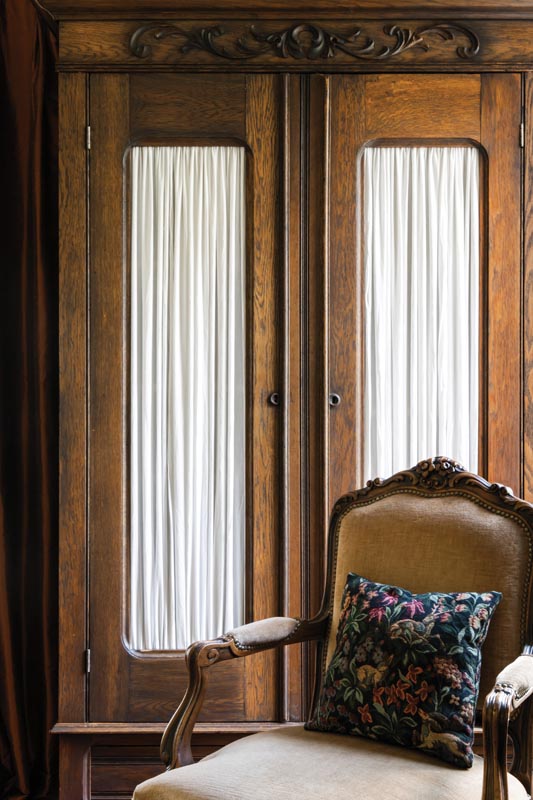
In the primary, a tall armoire with light curtains anchors the space. It’s one of the few close-to-period-appropriate antiques in the restored and reimagined home.

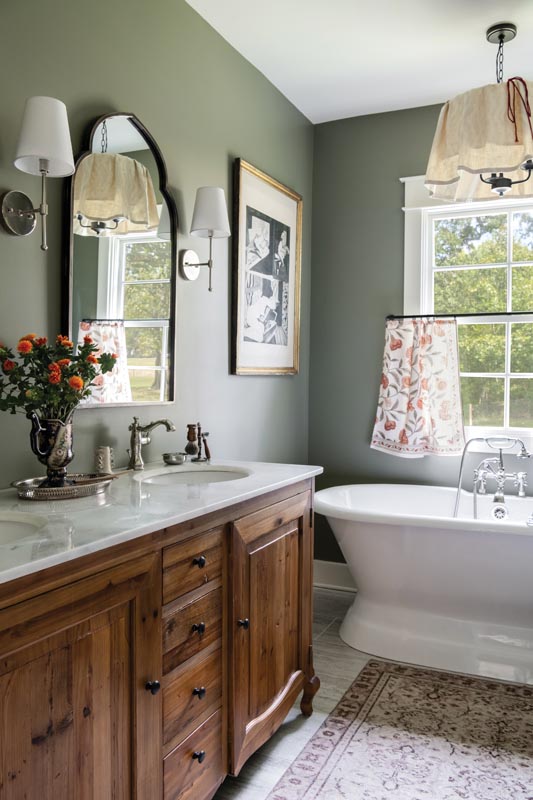
Capps and Stacey both love that the piece and its era alignment. But neither believe it’s necessary (or necessarily optimum) to hew rigidly to a historic home’s original era and its dominant design style.
“We’re definitely of the mentality that you don’t have to have every piece that’s specific to the time period in a house,” Stacey says. “We just want to make it something that you love looking at and you feel happy in.”
“Period appropriate” probably wouldn’t be period appropriate, anyway, from Capps’ perspective.
“At that time, unless people were really wealthy, they couldn’t buy all of their furniture at the same time,” she
says. “So it was a lot of collected pieces.”
LABOR, LOVE
On the back side of this collective “labor of love,” as the Fykes reestablish their roots and move on to restoring more of the long-ignored seven-acre property, Capps and Stacey are raking in high marks for a high-difficulty-level project.
“They’re obsessed with it,” Capps says of the homeowners, beaming. “They love it.”
And who knows? Maybe in another 145 years, future generations of Fykes will tell the story of the family farmhouse’s unexpected resurrection, sitting together at and on these carefully picked, lovingly placed antiques.
“They’ve lasted this long,” Capps says. “They’ve lived through so many families, and so many children. And they’re still trucking.”